What's new?      Anicums      Services      Contact      Agents      About Us     

Állategészségügy
Gyógyszer
Állattenyésztés
Villanypásztorok
Fejés tejkezelés tejfeldolgozás eszközei
Kisállattartás
Lovas
Méhészet
Mesterséges termékenyítés


  Basket contains:
  The basket is empty.
Show basket


Login
Sign up

If you are a member, you can sign in here, so that you don't have to give your data before shopping again


KÓNYA'S ROTATING BROODFRAME BEEHIVES

HISTORICAL BACKGROUND
Apiaries face serious concerns all over the world. The major causes are well known for every beekeeper. Agricultural production has changed. Owing to wide-spreading of monolithic growing and their programmed chemical plant protection, Earth's flora and fauna has been hurt permanently and nature's balance has been lost. In the apiaries, besides the formerly prevalent diseases, new ones appeared to endanger safety of production. Following the appearance of Varroa destructor mites, a beekeepers lost smaller or larger parts of their stocks. In addition to mites, some panders (viruses, Nosema cerana) became world-famous. From the safety point of view, production and distribution of healthy foodstuffs is a first-class interest that is not feasible when chemicals are used. Well, there must be a protection against diseases. Protection can be based on biological methods that should be safe and efficient to provide chemical-free but successful production. Economic environment has also changed. For making a good living for beekeepers, an important measure of value for them that how many colonies they are able to care for.


12 years ago, Lajos Kónya, an experimentalist beekeeper sought answers to the above questions. First, he created a rotating hive then its advanced version, the so-called rotating broodframe beehive. ANIVET's excellent organizer Péter Váraljai recognized the apiarian value of this invention. An agreement on starting pilot production was concluded between ANIVET Ltd. and Mr. Kónya. Then manufacturing and distribution began. Moreover, based on the remarks of beekeepers attempting to eliminate deficiencies, design of the rotating broodframe beehive was improved within a short period. This improvement could be traced in the material, mechanics of the rotating broodframe beehive as well as its method of rotation and control. A result of improvements is the currently launched rotating broodframe beehive, for the use of which ANIVET Ltd. as a distributor wishes good health for both bees and beekeepers.

DESCRIPTION OF ROTATING BROODFRAME BEEHIVES
Beehives are equipped with nine rotating frames in the brood and an automatic rotating mechanism each. The surface areas of rotating frames are identical to those of the broods in Dadant-type beehives. The bottoms of beehives provide a generous ventilation capacity that prevents bees from getting in draught although give a satisfactory air change. (Attention: Even in winter, it should be left entirely free to prevent overheating.)
The exit can be narrowed or expanded, according to the strength of the particular colony.
Brood frames are made of plastic and they should be provided with a thin wax layer. Apply the wax heated to 80 d. c. (176 d. F) by means of a paint-roller). Test operation of rotating parts before attempting settling.
Various honey supers such as Dadant, Hunor, Félkeretes (half-framed) etc. can be attached to the brood chambers of beehives via adapters. Hives can be ordered either with honey supers and tops or without them. For rotating a hive, an additional storage battery can also be ordered. Alternatively, if its capacity is sufficient, several hives can be connected to one storage battery.
 
SETTLING BEES INTO THE BEEHIVE
As long as an apiary does not have an established rotating frame, the most practical way of settling is using brushed colonies formed by a mass of bees of 2 to 2.5 kg utilizing a new breeding queen. Place the freshly settled hive in a cool place for at least 3 days. For feeding, use weak sugar syrup so that bees may establish the frames of the rotating broodframe as quickly as possible and that the colony may grow familiar with the new queen. In the evening of the third day, when bees otherwise will not fly, the hive can be set onto its permanent place. Go on feeding until frames will be occupied entirely by the bees and filled with brood and honey. In the busiest foraging season, feeding can be suspended. In the year of settling, do not reckon any outstanding honey production (just like with other types of hives) because of the difficulties of the artificial colony's generation change. The most suitable time for settling is the blooming period in the field providing the first significant yield in that year and the period immediately following it, provided that an uninterrupted foraging is still ensured in that neighbourhood.
After settling, rotation must not be started unless the capped brood has already extended. The brood chamber must be provided with a honey stock to secure safe wintering. In the year of settling, honey supers can be put to use, depending on foraging.
If we already have an adequate number of rotating frames with built combs, settling can be performed by the usual dividing of colonies. Settling can also be carried out by introducing the colony located in the honey supers to the brood in case there is satisfactory foraging and/or abundant feeding.
 
ADVANTAGEOUS FEATURES OF ROTATING BROODFRAME BEEHIVES:
The Kónya's rotating broodframe beehive is the most advanced mechanized hive in the world where the dominant part of human work is carried out by a machine and an electronic unit. By utilizing it, the number of bee colonies can be multiplied in relation to those in a conventional apiary. Consequently, professional beekeepers can attain more income at less manual work by utilizing this up-to-date technology.

Another great advantage of this type of hives is, at its scheduled and controlled operation, that reproduction of bee mites in the capped broodcells becomes minimal. Therefore, chemical protection against mites during the honey production period is not necessary. As a result, "bio honey" containing no agent residues can be produced.
       
An invaluable advantage of rotating broodframe beehives is swarm prevention  
During a swarming period, colonies will draw swarmcells onto the broodframes. The circular frames are rotated by 180 degrees per day. The queencells looking downwards in natural circumstances will look upwards on the following day. Bees do not accept this situation and chew queencells even when they contain a thriving larva queen. Considering that they will be unable to raise a new queen, swarming will be impossible. With unswarmed colonies, production will be continuous in full force at high safety. Utilization of fields will be less dependent on process troubles arising from peak work periods in traditional apiaries.
 
Rotation of the brood
Rotating broodframe beehives are operated by a battery-powered 12 V motor. They are equipped with an electronic unit providing a full automatic control. The electronics is programmed for two speed stages.
The rotating frame will be rotated by about 180 degrees during 24 hours by means of the control unit. It happens in two ways, as follows:
1.In position "0" of the mode switch, frame is rotated by about 8 degrees to result a sum of 180 degrees within 24 hours.
(for scheduled confining the reproduction of Varroa destructors as well as for an early-spring stimulation)
2. In position "1" of the mode switch, the frame is rotated by 180 degrees step-by-step at one go within 24 hours. Each 8-degree rotation is followed by about a one-minute stop. Thus, the complete rotation takes place within about 25 minutes (for, first of all, elimination of swarming, partly for confining the reproduction of mites, a quick removal of honey stock gathered in the brood, an increase in the volume of broodcells)
   
Manual mode:  
Move the rotating drum to the desired position by continuously pushing the button MAN. You can turn the mode switch to the other position any time and the relevant mode will be effective during the subsequent cycle.
 
The motor is prevented from overload by a "renascent" fuse whose operation is acknowledged by a blinking LED. Regeneration time of the "renascent" fuse is about 1 hour.
 
Attention! There are periods when rotation is not allowed, namely, from the end of summer until the middle of spring, that is, from contraction of colonies until the generation change in spring. Rotation is not practical either in a prolonged foraging-free period in summer, except for the case when feeding is sufficient.
 
A BEGINNING OF ROTATION  
During the wintering period and in early spring, rotating broodframe beehives exist in a restricted position, without honey super. At the end of March and at the beginning of April, broodcells are increasingly spreading in the brood. Before attempting to rotation, broodframes must be relieved of the possible brace combs that may prevent rotation. You should not beware of this work. By using a suitable special tool (wide steel sheet), it takes only some movements.
Simultaneously with this procedure, it is expedient to insert to one side (next to the frame containing honey and pollen, and the capped broods) a frame containing few honey or opened, unsealed honey cells. Before closing the hive, start a test run. If the machine operates well, close the hive and switch to the first speed. Rotation will take place throughout 24 hours and the characteristic noise of rotation makes checking easy.
Rotation can be performed either in the morning, at noon or in the evening. No matter when but it is expedient to set it to that time when the beekeeper supervise his/her apiary. One rotation per day does not disturb the bee colony. As a result of rotation, bees will reorganize the brood every day, instead of the apiarist. Bees take apart the remnant winter brace combs and carry them into the honey chamber or the two side-combs. Thus, the brood becomes more and more expanded, almost of itself. The brood comb will contain only broodcells except for the two side-combs filled with honey and pollen. Never take these away because they provide the reserves of the colony for the forage-free season. The reproduction of mites will be restrained. During blooming of fruits and/or when the first major foraging starts, put a honey super on top of the brood box.
   
SWARMING SEASON   
At the end of April, when rape is blooming, most bee colonies reach the peak of their development, and are desirous of doing reproduction and swarming, driven by their natural instincts. The whole colony will be overwhelmed with swarming fever, will start to build queen cells, and stop foraging. This process is against the beekeeper's interest as swarming may cause a severe drop in production. One of the main reasons for awakening of swarming fever is the dominant number of nurse bees, which leads to royal jelly overproduction. The main task of the colony with swarming instincts is not foraging but splitting, and so they concentrate on rearing swarm cells. Bees cluster by the exit hole even in daytime (festoon).
For the avoidance of that, besides the traditional apiary treatment, methodical reproduction by dividing of colonies is necessary. By removing a brushed colony, the number of nurse bees lessens and swarming fever will cease to exist. Over-reproduction of population is also harmful with rotating broodframe beehives. As there are no queens hatching from the cells, colonies will not swarm. Therefore, beekeepers will not be late at dividing of colonies; overpopulation is not favourable for a lively foraging. Therefore, abundant population should be removed from the colony. During the swarming season the rotation must be set to 2nd speed mode (position 1) to safely prevent bee colonies from building a swarmcell. Brushed colonies provided with mated queens should be kept in a cellar for three days, and then settled in new hives.
   
MIGRATION WITH CONTAINERS   
Fix the honey supers on the day before migrating. Before starting, shut the exits, and open the bottom ventilation hole at 4-5 o' clock in the morning. One person can manage four containers in maximum one hour. When the transport vehicles have arrived, attach the beehive trailers, and check their technical status /indicators, brake lamps, lights, and pneumatic brakes/. Migration is only permitted with a technically perfect beehive trailer. When the convoy starts, the beekeeper should escort it. In case a problem arises (accident, traffic jam etc.), the top ventilation hole should be opened. Organize migration so that the convoy may reach the new field by 8 to 9 o'clock a.m.
 
EXTRACTING HONEY
During the production season, there are always two honey supers in use and a third, spare super. Always the bottom drawer is filled first. When the upper drawer is over half-full, you can remove the bottom one for extraction. Place the top drawer to the bottom, and the spare drawer on the top. This cycle ensures that the honey will always be mature. You can take away the honey supers with the use of escape chamber, sweeper and blower. Honey collection does not require any specific knowledge. A properly trained worker can perform this task.
SUPERSEDURE
The life of a colony depends on the quality of queen. An important precondition for successful honey production is that there should be a young, well-breeding queen of no more than 2 years of age. The best season for supersedure (queen replacement) is from May to June.
Carry out supersede as follows: remove the brood frames one by one, find the old queen and kill her. Replace the frames and place the new queen in the cage, in a position that enables the bees to chew them off and fasten her between the frames so that if frames rotate the cage may stay in place. In two days, remove the empty cage and in ten days check broodcells.
Introducing the queen is more successful by using a queen disc that should be stitched to the frame so that there may be areas on the surface beneath the disc both for honey and for breeding where the queen should be confined. Initially, bees are not able to get into the cage through the gaps in the disc, but they feed the queen. The queen starts breeding. In 4 to 5 days, the disc may be removed.
 
Providing circular frames with wires and drawing artificial combs  
Depending on decision, according to the frames on sale, by agreement.
   
PREPARATIONS FOR WINTERING  
From the middle of July on, broodcells should be extended on schedule so that sufficient number of well-fed young bees may go to wintering. To that aim, ample space should be provided for the extension of the brood, and failing continuous foraging a stimulating feeding should be applied.
During the year, rotation of the broodframe hive was uninterrupted unless a malfunction occurred. Set the cycle of rotation at the beginning of the year to speed I (position 0), at the beginning of swarming period to speed II (position 1) then again to speed I (position 0).
Rotation does not support reproduction of mites. Even so, we esteem tracing the numbers of mites important, because appearance of considerable number of mites may occur any time in colonies either because of the vicinity of an unattended infectious apiary or owing to a longer break in rotation. In general, the number of mites will not increase above 300 provided that rotation was performed according to instructions. If the estimated number of mites has still exceeded the said standard, the number of mites should be lessened fewer than 300 before attempting to grow a wintering population. (The number of mites dropped onto the monitoring sheet during 24 hours in natural conditions is 0.2 to 0.3 as an average of several monitoring hives.)
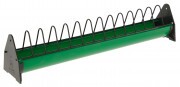
At the latest, in the middle of August, stop rotation and remove the honey super. If there is no forage taken into the escape chamber, supply the tray feeder with liquid bee feed. Upon stopping rotation, the colony immediately draws a brace comb above the broodcells in the circular frames.
The feed intended for wintering is honey of about 15 to 20 kg. When the brood is provided with the winter feed consisting of the sufficient volume of honey, remove the feeder. Fill the escape chamber with a warm, thick blanket and cover it with the top. It is not necessary to put a side-cover or a reducer in the brood chamber. In late autumn, reduce the exit hole and put on the entrance reducer.

   
PROTECTION AGAINST MITES IN AUTUMN  
In a rotating broodframe beehive, chemical protection must be used against survived or brought-in mites on one occasion in late autumn, in the brood-free period. If you wish to retain the ability to produce bio honey in your apiary then use nothing but oxalic acid fume or some other agent that is authorized for use in a "bio apiary". In autumn, perform mite control so that the average number of dropped mites after treatment may be below 1 mite on the plastic sheet inserted in the lower ventilation holes (fewer than 10 mites per colony).


sAniVet - Centre of Animal Breeding